Where Cable Cost Sits in a PV Project Budget
Cable is not the largest line in a PV budget, but it is one of the few the buyer can still change after the array design is frozen, and the published figures show why that choice is measurable: KUKA CABLE lists a nominal weight of 59 g/m for its 4 mm² solar cable, 78 g/m for 6 mm² and 130 g/m for 10 mm². The site publishes no unit price for any of them, so the workable approach is to quantify the material per metre and the joints per run, then compare offers on those numbers.

Key takeaways
- Material per metre is published: 59 g/m at 4 mm², 78 g/m at 6 mm², 130 g/m at 10 mm².
- Conductor construction is published too, so strand count can be checked against the datasheet: 84 strands of 0.29 mm in the 6 mm² version.
- The manufacturer publishes no unit price, per-metre price or minimum order quantity on the pages read.
- Service life is given as 25 years or more, which is the period a purchase has to be spread across.
The three figures a specifier can actually control
In a ground-mounted or rooftop array, most of the capital sits in modules, mounting and inverters. Cable appears later, in the balance-of-system lines, and that is where a specifier still has room. Three published figures move together: the cross-section, the conductor construction and the nominal weight per metre.
Cross-section sets current-carrying capacity and voltage drop. Conductor construction decides how flexible the finished cable is — the site describes a class 5 flexible tinned copper conductor to IEC 60228. Weight per metre is the honest summary of both, because it includes the metal, the XLPO insulation and the XLPO sheath that has to be extruded over it. A quote that names a cross-section but not a diameter or a weight is quoting a label rather than a cable.
There is a fourth figure nobody prints on the drum: the number of joints. Every extra metre of trench, every corner in a tray and every string that has to reach a combiner box adds a termination, and terminations are labour. Cable priced per metre ignores that; a project budget does not.
Where the conductor mass is fixed
Strand counts published for the 1500 V solar cable family make the comparison concrete. The 4 mm² build is given as 56 strands of 0.29 mm, the 6 mm² as 84 strands of 0.29 mm and the 10 mm² as 142 strands of 0.29 mm. Going from 4 mm² to 6 mm² adds 28 strands; going from 6 mm² to 10 mm² adds 58. Tinned copper is used throughout, which is why the conductor resists corrosion at a cut end rather than relying on the sheath alone.
Insulation and sheath thickness are published as well: 0.7 mm of insulation and 0.8 mm of sheath for the 1.5 mm² to 10 mm² sizes, rising to 0.9–1.7 mm and 0.8–1.7 mm on the larger builds. Over-specifying a cross-section therefore buys metal and polymer at the same time. Under-specifying it buys voltage drop and heat, which no later purchase order can undo. Only one of those two mistakes shows up in the budget line.
Putting a figure on a metre
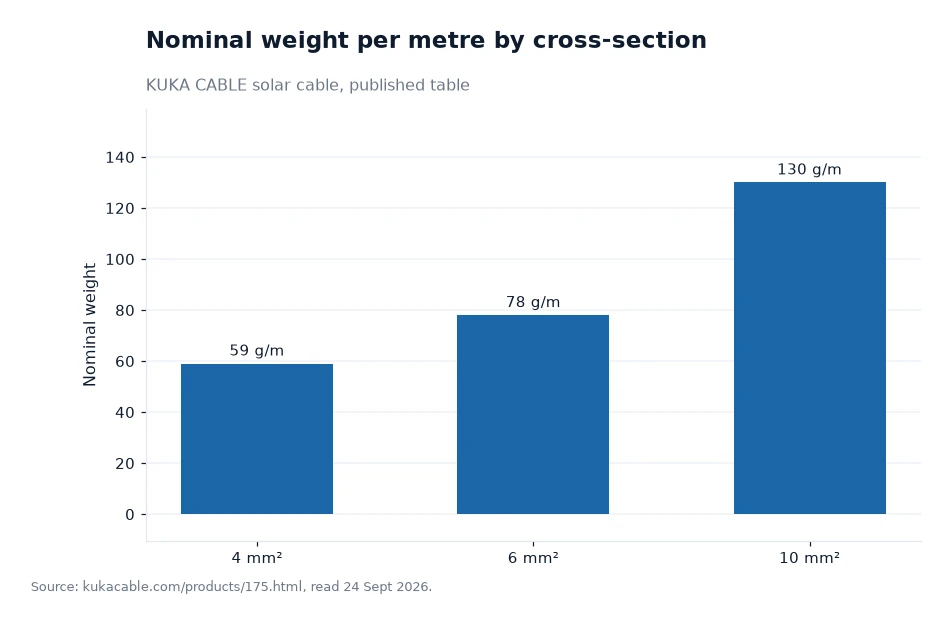
Read the three bars as a material ratio rather than as a price. The 10 mm² bar is roughly 2.2 times the height of the 4 mm² bar — 130 divided by 59 is 2.20 in my own arithmetic — so a run specified one size too large pays more than twice the cable mass for capacity the array may never call on.
The same table is a useful check on a supplier's paperwork. Nominal weight and nominal diameter both appear, together with the conductor construction, so a buyer can ask for the measured diameter of the delivered drum and compare it with 5.5 mm at 4 mm², 6.0 mm at 6 mm² or 7.5 mm at 10 mm². Small deviations matter less than a systematic shift, because a systematically thinner cable is usually a smaller conductor inside a full-size jacket.
What is missing from the published pages
The pages read for this article publish no unit price, no price per metre, no minimum order quantity and no lead time. The manufacturer does publish a downloadable catalogue and datasheets, a free sample offer on product pages, and a contact route on every page: phone 0086-18317109559 and [email protected].
That gap is normal for a project-grade cable and it changes how a buyer should work. Instead of asking for a solar cable price and comparing two totals, list the deliverable figures — cross-section, conductor construction, diameter, weight per metre, test voltage, certificate name — and put both suppliers against the same list. Any figure missing from one quotation becomes a question with a written answer, and the comparison stops being about adjectives.
| Cross-section | Conductor construction | Overall diameter | Nominal weight | Typical role in the array |
|---|---|---|---|---|
| 1.5 mm² | 39 × 0.25 mm | 4.6 mm | 34 g/m | Short signal and sensing runs |
| 2.5 mm² | 49 × 0.25 mm | 5.0 mm | 45 g/m | Small strings and jumpers |
| 4 mm² | 56 × 0.29 mm | 5.5 mm | 59 g/m | Common string cable on residential roofs |
| 6 mm² | 84 × 0.29 mm | 6.0 mm | 78 g/m | Longer string runs and commercial roofs |
| 10 mm² | 142 × 0.29 mm | 7.5 mm | 130 g/m | Home runs and combiner feeds |
| 16 mm² | 238 × 0.29 mm | 8.8 mm | 190 g/m | DC collection between sub-arrays |
Worked example
Take a 1,000 m DC run and price the material by weight, using only the published figures. At 4 mm², 59 g/m multiplied by 1,000 m gives 59,000 g, or 59 kg. At 6 mm², 78 g/m multiplied by 1,000 m gives 78 kg. The difference is 19 kg, which is 19 divided by 59, or about 32% more material. This is my own calculation from the published nominal weights; it assumes a straight multiplication by length, and it counts conductor, insulation and sheath together rather than copper alone, so it excludes drum, packing and offcuts.
Now add the second half of the decision. A 6 mm², 1,000 m run has the same number of terminations as a 4 mm² run, so the extra 19 kg buys lower voltage drop and lower conductor temperature with no extra labour. On a 300 m run the same comparison gives 78 minus 59, times 0.3, for a difference of 5.7 kg — the size of the gap falls with the length, which is why short strings are usually specified at the smaller cross-section. Both calculations are mine, from the two published weights.
Frequently asked questions
Does KUKA CABLE publish a price per metre?
No. The site publishes no unit prices, per-metre prices or minimum order quantities for any product, but it does publish the nominal weight per metre, the conductor construction and the overall diameter for each cross-section, so offers can be compared on measurable figures instead of on price alone.
Which cross-sections does the manufacturer list as standard?
The solar cable pages name 4 mm², 6 mm² and 10 mm² as the commonly used specifications, while the published table runs from 1.5 mm² to 240 mm². Single-core and twin-core versions are both described, and the 1500 V product page covers a 6 mm² cable in black or red.
What to check before the budget is signed off
Ask three things in writing. First the datasheet for the exact model, so the weight per metre and the diameter can be read off rather than assumed. Second the drum length and the packing, because a nominal weight multiplied by a nominal length is only useful if both are stated. Third the test record that travels with the batch; the manufacturer publishes a spark test at 10 kV during production and a finished-cable test voltage of 6.5 kV AC, 50 Hz for five minutes.
Then compare the numbers with the published table and with the standards named on the product pages. The solar cable range is described against TUV 2PfG 1169/08.2007, EN 50618:2014 and IEC 62930, and the company states a service life of 25 years or more for a cable that is installed correctly. A purchase spread across that period is easier to defend than one explained by a discount. Contact details and the full cross-section list are published on the manufacturer's own pages, including the home page, the solar cable range and a published test list, so the figures above can be traced back before a budget is fixed.
Cost inputs here are the manufacturer's own published weights and dimensions; the g/m table was collated 24 Sept 2026[1].