When to Reset a Conversation
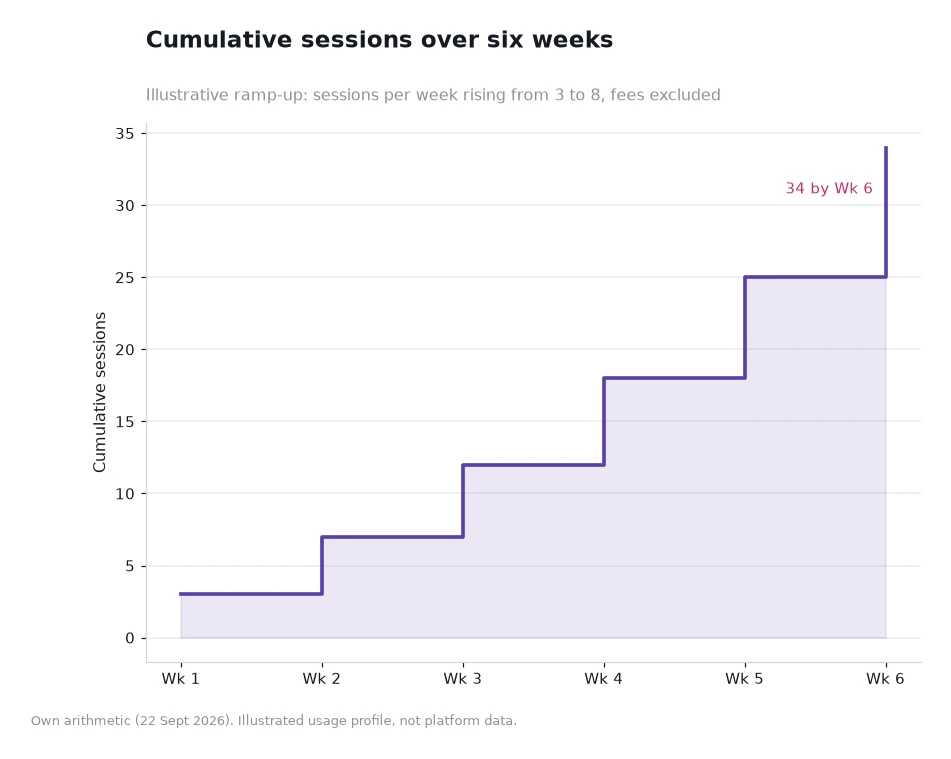
A conversation earns a reset when its context has stopped helping and started steering. Four signals do that: the topic has moved twice without a clean break, the character's voice has drifted from the description, a stated detail has been contradicted, or the session takes longer to re-enter than it takes to hold. On the ramp used below that happens perhaps eight times across 34 sessions over six weeks.
Key takeaways
- Reset on contradictions, not on boredom. A contradiction inside remembered context is the one fault a long conversation cannot repair by itself.
- Carrying stale context has a price: eight minutes of re-anchoring per confused session, or 64 minutes across eight such sessions on the ramp below.
- Reset by re-briefing, not by starting cold: one or two lines restating tone, setting and what you want avoids repeating the first hour.
- Keep at most two live conversations per card. Three or more open threads is where contradictions start inside a single account.
Four signals that a reset is due
The first signal is topic drift. A conversation that began as one kind of scene and has wandered through three unrelated ones is not broken, but it is carrying weight it does not need. You can feel this the moment the opening lines of your next message have to explain where you both are, what just happened, and why it matters.
The second is voice drift. The platform describes its characters as giving natural, adaptive responses that recall previous interactions and adapt over time, and adaptation is usually a feature. It becomes a problem when the adaptation is toward whatever the last twenty messages rewarded, so a character that started dry and reserved is now entirely something else. When the voice no longer matches the description you chose the card for, the card has been overwritten by its own history.
The third is contradiction, and it is the clearest case. If a detail you established early - a place, a name, a relationship - comes back wrong, the conversation has already outlived its memory. You can correct it once. If the same contradiction returns within a few messages, a reset is cheaper than the repair.
The fourth is friction. This one is subjective and easy to measure anyway: if the section of the conversation you have to re-read before replying has grown longer than the reply itself, the context has become a reading task. That is the moment to reset, because the next ten messages will otherwise be spent summarising the previous fifty.
What stale context costs
Stale context is not free. It costs you the messages you spend restating things the character should already know, it costs you a cold start each session because the thread is too long to reload quickly, and it costs a kind of attention that is not the point of the activity. Individually these are small; multiplied over a habit they are not.
There is also an accumulation problem specific to accounts rather than conversations. Memories and open threads build up in the same place, and a card you have had five overlapping conversations with is harder to predict than one you have had two with. The discipline that keeps this manageable is unglamorous: keep the live set small, close what you have finished, and let the description rather than the backlog define the character next time.
Resetting is also reversible in the ways that matter. Nothing you learned about the card is lost - you still know the tags that worked, the tone you liked and the creator's style - and those are the parts worth carrying forward. What you leave behind is the accumulated improvisation, which is exactly the material that caused the contradiction or the drift in the first place.
| Trigger | What you notice | Cheapest repair |
|---|---|---|
| Topic drift | Every reply needs a recap before it makes sense | One-line re-brief, then continue the current thread |
| Voice drift | The character no longer matches the description you chose | Reset and re-describe the tone you want in the first message |
| Contradiction | An established detail returns wrong, twice | Reset; the memory the thread depends on has already failed |
| Friction | The recap you re-read is longer than the reply you write | Start a fresh conversation on the same card |
| Long absence | Returning after weeks with no clear entry point | Reset with a two-line summary of what you want from the card |
Worked example: how many resets a six-week habit needs
Start from the ramp plotted below, which is illustrative arithmetic: weekly session counts of 3, 4, 5, 6, 7 and 9, adding to 34 sessions across six weeks, an average of 5.7 a week with one extra session in the final week.
Assume one session in four ends with a conversation that needs resetting - a rate that matches the friction signal showing up roughly weekly for anyone running six sessions a week. One in four of 34 sessions is 8.5, so figure eight resets across six weeks. If each confused session costs about eight minutes of re-anchoring and restating, that is 8 times 8, or 64 minutes, which is one hour of the six-week period spent repairing context rather than using it.
Compare that with the cost of resetting. A careful reset - two lines of re-briefing, plus the first ten messages to re-establish tone - is about six minutes. Eight resets is 48 minutes, or roughly 12 minutes a week, and it removes the repair work rather than duplicating it. Every number here is an assumption built to show the arithmetic and not a measurement of any account.
How to reset without starting over
Write the re-brief before you open the new conversation, in two lines. The first line is what the card is: tone, setting, the version of the character you actually liked. The second is what you want from this session. Two lines take about forty seconds to write and give the character a starting position instead of a blank page, which is the difference between a reset and a restart.
Then use the right entry point. If you are resetting the same card, open it from its own entry rather than from the old thread, so the new conversation begins from the description rather than from an afternoon of accumulated improvisation. The trends page is a useful cross-check here: the NSFW AI trends shelf shows each card with its counters and tags, which is a fast way to remind yourself what a card was before you overwrote it with history.
Keep the reset log cheap. One line per reset - date, trigger, what you changed - and nothing else. After a month the log tells you which cards you keep resetting and which ones never need it, and that is more useful than the conversation you were trying to save. A reset habit that costs twelve minutes a week is affordable; a repair habit that costs an hour every six weeks is the one to replace.
If you want the mechanics in more depth, the Crushon page for ai porn chat is the plainest statement of the adaptation model, and its FAQ is where the platform uses the term Porn Chat AI while explaining how characters recall previous interactions and change over time.
Frequently asked questions
How do I know a reset is overdue?
When you spend longer recapping what happened than writing the next reply, or when an established detail returns wrong for the second time. Both mean the context is working against you.
Does resetting lose the character's memory of me?
It ends that conversation's accumulated history, not what you know about the card. Two lines of re-briefing on the next opening message restores the tone you were using.
How often should resets happen?
About one session in four is a workable rate. On a 34-session ramp that is eight resets, or roughly twelve minutes a week if each one takes six minutes.
Reset early, and keep the note short
Choose your trigger now, in advance, so the decision is not made in the middle of a session that has already gone sideways: contradiction twice, or a recap longer than a reply. When either happens, write two lines of re-brief, open the card fresh, and spend ten messages re-establishing tone. Then note the reset in one line and move on. A habit that resets eight times in six weeks and never needs a long repair is healthier than one that keeps a conversation alive out of sentiment.
Data: platform wording on adaptive responses and the trending shelf counters, read 22 Sept 2026[1]. Session counts, reset rates and minute figures are own arithmetic presented as an illustrative profile, not platform data. This piece is written for readers aged 18 and over.