Using sensory experiences in brand marketing fails for a predictable reason: the brief is written after the first call rather than before it. A marketing team arrives with an ambition, the supplier answers with what it can build, and the project acquires a shape nobody chose. For a retail own brand, where the activation has to sell product rather than simply impress, the preparation matters more. Three things belong in the room before the first conversation: the commercial objective, the shelf reality, and the way success will be measured.
Key takeaways
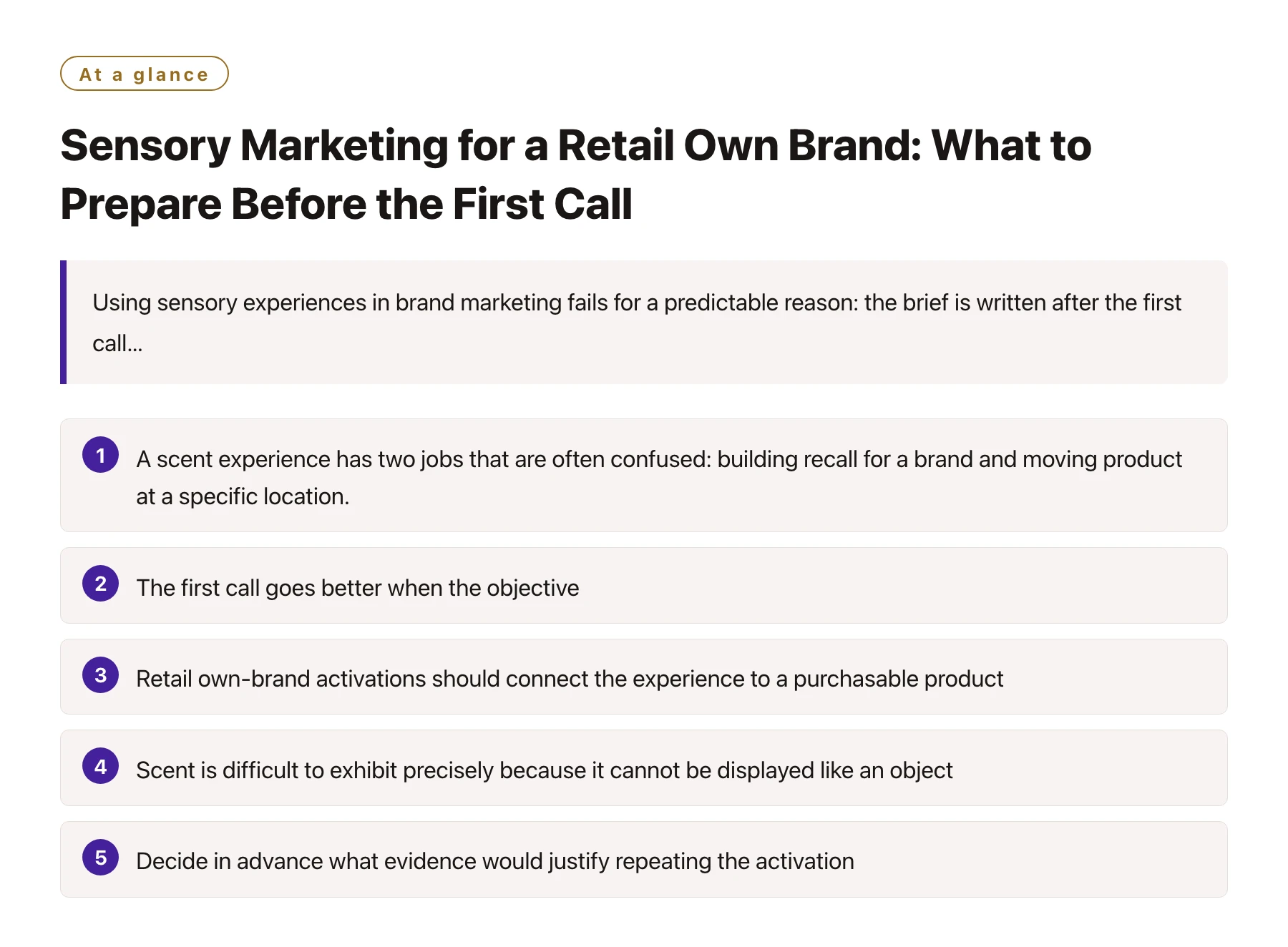
- A scent experience has two jobs that are often confused: building recall for a brand and moving product at a specific location.
- The first call goes better when the objective, the space and the measurement plan are already written down.
- Retail own-brand activations should connect the experience to a purchasable product, or the recall has nowhere to land.
- Scent is difficult to exhibit precisely because it cannot be displayed like an object, which is why sensory design work is more about sequence and context than decoration.
- Decide in advance what evidence would justify repeating the activation, because an experience that cannot be evaluated will not be repeated.
Walking through a scent exhibition is a useful reminder of how much of the work is invisible. What feels effortless is a sequence of decisions about intensity, order, spacing and dwell time, and those decisions are made long before the visitor arrives.
This article is written for the marketing or brand lead inside a retailer that is considering a sensory activation for an own-brand fragrance range. It covers what to prepare before contacting a partner, and what to be honest about internally.
What a scent room teaches a marketing team
The most useful lesson from a well-built scent environment is about pacing. A visitor can hold only a few scents in conscious memory at once, so exhibitions sequence them: an opening, a small number of distinct moments, and somewhere to rest. Retail activations that ignore this and present eight fragrances in a row usually produce a shopper who remembers none of them.
The second lesson is about context. Smell is difficult to exhibit on its own because it has no object to look at, which is why sensory work leans on material, image, sound and language to give the scent somewhere to attach. A facility such as the immersive scent museum in Guangzhou - described by the company as the world's largest fragrance museum - is essentially a long study in that problem, and it is worth visiting with a product question rather than a curiosity.
The third lesson is measurement. Exhibition practice treats the visitor route and how long people stay as design variables rather than accidents, and those variables are observable [1]. A retail activation can be observed the same way, which is the difference between an experience that can be repeated and one that is remembered as a nice afternoon.
What to prepare before the first call
Suppliers read preparation as seriousness, and it changes the quality of the first conversation more than any brief template. Four items are worth having written down.
The commercial objective. Is the activation meant to launch a range, revive a scent that has gone quiet, lift basket size in one store cluster, or generate content? These are different projects. A launch wants footfall and a hero product; a revival wants existing buyers to re-smell something they already know; content wants visual and narrative assets more than throughput.
The space and its constraints. Square metres, ceiling height, power, floor loading, ventilation, noise, the route a shopper already walks, and the hours the space is staffed. Sensory installations are more sensitive to ventilation and airflow than most retail fit-outs, and a supplier who has not seen the space will design for an imagined one.
The product you intend to sell. A scent experience without a purchasable product beside it creates a memory with nowhere to land, and the shopper's next action is unclear. Deciding which SKUs the activation supports - and whether the format is bespoke fragrance development and production or an existing line - is part of the brief, not a detail for later.
The measurement plan. Traffic, dwell time, number of scent interactions, sampled units, sell-through in the activation store against a comparison store, and content produced. Pick two or three, decide them now, and write down what result would justify repeating the programme.
Bring the team's scent vocabulary, not just its brand guidelines
Marketing teams discuss scent in adjectives; perfumers work in structures and materials. Bridging that gap early saves rounds later, and it is the practical reason to invest in scent education for a brand or retail team rather than treating it as a reward. Programmes such as the ones offered at a place to learn perfumery exist to give commercial teams the language to describe what they want without guessing at note names.
It also changes how internal approvals run. A team that can describe a direction as too sweet, too sharp or too flat gives usable feedback. A team limited to likes and dislikes tends to produce contradictory briefs, which is the most common cause of a stalled activation.
Industry bodies have spent decades on the same problem of public scent literacy, and their material is a legitimate reference for how to talk about fragrance without overclaiming [2].
Be explicit about what the experience cannot prove
An activation can demonstrate preference, recall and willingness to engage. It cannot demonstrate that a scent will sell at a price, in a different store, to a different shopper, or over a full season. Saying that internally before the first call prevents the most expensive outcome: a successful activation that is read as proof of a full rollout business case.
Museum practice offers a useful discipline here, because interpretation and collection care are treated as separate professional obligations with separate standards [3]. The commercial equivalent is to keep experience quality and commercial performance as two distinct measures rather than blending them into a single story.
What each preparation item answers
| What you bring | What it answers in the first call | What it does not answer |
|---|---|---|
| Written commercial objective | Whether the project is a launch, a revival or a content brief | How much the activation should cost |
| Space survey with ventilation and power | What is physically buildable in that location | Whether shoppers will walk the intended route |
| The product the activation supports | How the experience connects to a purchase | Whether that SKU is the right one for the range |
| Two or three success measures | How the programme will be judged afterwards | What the result will be before the test runs |
| Scent vocabulary for the team | Which direction is being asked for | Which materials the perfumer will ultimately use |
| A decision date for repeating or stopping | How long the pilot runs and what happens next | Whether the budget will be available next season |
Preparing these does not lengthen the process. It shortens the first call and removes the most common source of redesign, which is a supplier building against an imagined store.
Where sensory programmes go wrong
The recurring mistake is treating the activation as a standalone event. A scent experience that runs for three weeks, produces coverage and disappears leaves the shopper with a memory and no route back to the product. The version that works connects the memory to a range that is still on shelf, with the same scent available in a pack the shopper can buy.
The second mistake is over-designing the space and under-designing the sequence. Visitors remember order and contrast far better than they remember the quality of a display unit. Spending the budget on the first ten seconds and the transitions generally produces more recall than spending it on finishes.
The third is staffing. Sensory installations need someone who can talk about scent without reciting a script, and that person is the difference between an interaction and a queue. If the retail team is not part of the plan from the beginning, the activation will be explained differently in every store.
Reviewing how the manufacturing side has handled comparable programmes helps at this stage. Looking at brands Xuelei has manufactured for and asking which scent projects involved a public-facing experience tells you whether the partner understands the difference between a production order and an activation, and whether it has the patience for the second one.
Before the first call, write one sentence: this activation exists to make shoppers do X, and we will know it worked if Y moves. If that sentence cannot be written, the brief is not ready and the first call will be a brainstorming session rather than a project.
Sources
- Museums Association —— A professional body for museums, publishing guidance and research on museum practice and visitor experience.
- The Fragrance Foundation —— A non-profit organisation for the fragrance industry, running perfumery education programmes and industry recognition.
- ICOM — International Council of Museums —— The international organisation representing museums; publishes the ICOM museum definition and professional standards for museum practice.
Frequently asked questions
What should a retailer prepare before briefing a sensory marketing project?
A written commercial objective, a space survey including ventilation and power, the product range the activation supports, two or three success measures, and a decision date for repeating or stopping. Scent vocabulary for the team is a useful extra that reduces revision rounds.
How is a scent experience measured?
Traffic, dwell time, number of scent interactions, sampling volume, sell-through in the activation location against a comparison location, and content generated. Choosing two or three in advance is more useful than collecting everything available.
Do sensory activations work for an own-brand range?
They can, provided the experience connects to a purchasable product and a store that stocks it. Own-brand activations have the advantage of no channel conflict, and the disadvantage that the range may be less familiar to shoppers, which makes explanation more important.
Why is scent harder to exhibit than other senses?
Because it has no object to attach to. Visual and tactile exhibits can present the thing itself; scent needs context, sequence and supporting material to become memorable, which is why sensory design is closer to choreography than decoration.
Should the retail team be trained before the activation launches?
Yes, and earlier than feels necessary. Store colleagues explain the experience to everyone who asks, and a short structured briefing about the scents and the mechanic is usually more valuable than additional signage.