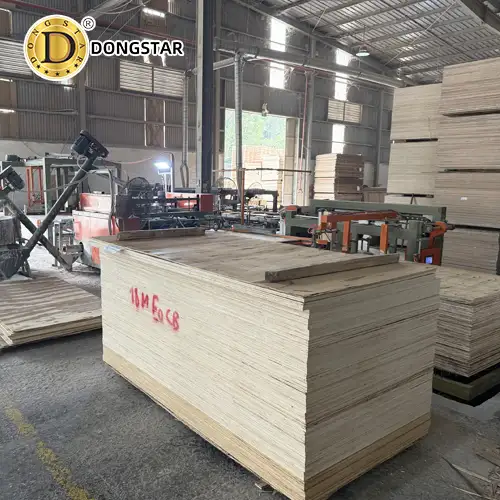
Choose commercial plywood by matching panel construction to its final use, not by thickness or sheet price alone. For an 18 mm furniture panel, check actual thickness across at least 10 sheets, veneer layout, bond quality, surface condition, moisture, flatness, machining behavior, and formaldehyde documentation. U.S. TSCA Title VI limits formaldehyde emissions from regulated hardwood plywood to 0.05 ppm, while European construction applications may also require documentation under EN 13986. A 5% rejection rate on 2,000 sheets equals 100 unusable panels before labor and machining losses are counted. Purchase specifications should therefore define measurable tolerances, test methods, and acceptance rules before production begins.
The first comparison should be based on the finished product. Cabinet sides, shop fittings, shelving, wall lining, upholstered-furniture frames, packaging, and laminated panels do not place the same demands on plywood. A 12 mm back panel mainly needs flatness and dimensional consistency, while an 18 mm shelf spanning 700–900 mm also needs adequate stiffness and reliable fastening around the edges.
That distinction matters because “commercial plywood” is not one universal construction. Panels sold under the same general description may use poplar, eucalyptus, birch, mixed hardwood, or mixed-species veneers, with different veneer thicknesses and densities. European definitions describe plywood as layers bonded together with adjacent grain directions usually at right angles, but the species and manufacturing details still affect the finished panel.
A buyer should therefore request a construction specification rather than accept a product name. For a 1,220 × 2,440 mm panel, useful purchasing data includes nominal thickness, agreed thickness tolerance, number of plies, face and back grade, veneer species, adhesive type, sanding specification, moisture range, emission class, and permitted repairs.
| Item to verify | Practical purchasing check | Why it matters |
|---|---|---|
| Thickness | Measure 4 corners and 5 interior points on 10 sheets | CNC grooves, edge banding and joint fit |
| Inner veneers | Cut at least 3–5 full-size samples | Reveals gaps, overlaps and weak areas |
| Moisture | Check several sheets from different packs | Reduces unexpected movement after machining |
| Flatness | Lay full sheets on a flat reference surface | Bowed panels affect cutting and lamination |
| Bonding | Request declared test method or class | Matches the panel to dry, humid or exposed service |
| Emissions | Match documents to destination market | Prevents compliance problems after import |
Thickness deserves more attention than a label such as “18 mm.” Automated furniture production can expose small differences because a CNC program may cut hundreds of grooves to one fixed dimension. If panels range from 17.2 to 18.4 mm, a joint designed around 18.0 mm may become loose on one batch and too tight on another.
Sampling should cover different positions in the shipment rather than 10 sheets from the top of one pallet. A practical incoming inspection might take panels from the top, middle, and bottom of several packs, record every measurement, and calculate the range. Even a 2% dimensional rejection rate becomes 40 rejected sheets in a 2,000-sheet order.
After thickness, cut the panel and inspect the inner veneer structure. Face quality can look excellent while cut edges contain gaps, veneer overlaps, poorly joined strips, or locally thin veneers. Problems near screw positions can reduce fastening consistency, while gaps exposed by routing can require filling before painting or edge finishing.
For furniture production, test the material using the same tools planned for the order. Drill hinge cups, route grooves, insert screws near panel edges, apply edge banding, and cut narrow strips. Testing 20–30 components provides more useful manufacturing information than examining one small showroom sample because machining exposes defects that remain unseen in a full sheet.
A full-size production sample tells more about commercial plywood than a polished 300 mm display piece.
Surface grade should then be matched to the finish. A plywood panel covered on both sides with HPL does not need the same decorative face as a clear-coated furniture panel. Paying an extra 8–12% for a visually cleaner veneer can be unnecessary when the entire surface will disappear below laminate, although sanding quality and local depressions still matter.
Visible surfaces require another inspection method. Check patches, open splits, sanding marks, color variation, veneer joints, filled knots, and repairs under normal production lighting. A defect that appears minor on one sheet can become repetitive when 500 cabinet fronts are manufactured from the same grade.
Bond performance must also match moisture exposure. APA notes that plywood bond classification describes the moisture resistance of the adhesive bond rather than panel strength or decay resistance; its Exterior classification is intended for repeated wetting or long-term weather exposure, while Exposure 1 is not intended for permanent weather exposure.
For European projects, do not treat a supplier’s phrase such as “waterproof glue” as a test result. Request the declared standard, test report, product designation, and intended service conditions. EN 13986 is used for wood-based panels in construction, and current European technical documentation lists EN 13986:2004+A1:2015 for relevant wood-based panel applications.
Moisture should be reviewed alongside bonding because wood still exchanges moisture with surrounding air after production. A panel shipped from one climate and immediately machined in another may change slightly while reaching equilibrium, especially when packs are opened and both faces are exposed at different rates.
For repeat orders, record moisture readings from several boards rather than relying on one number supplied for the shipment. If 30 sampled sheets show a narrow range, production is easier to control than when the same sample contains widely separated readings, even when the average appears acceptable.
Flatness deserves its own acceptance rule. Bow and twist can interfere with CNC vacuum tables, automated saws, pressing, laminating, and cabinet assembly. Inspect full sheets rather than cut samples because a 100 mm coupon cannot show whether a 2,440 mm panel bows across its length.
A factory using 1,000 sheets per week can lose substantial labor if operators repeatedly clamp, flip, or reject warped material. Recording flatness complaints by batch also helps separate storage problems from production problems instead of relying on visual impressions several weeks later.
Formaldehyde documentation becomes more important when plywood enters regulated markets. In the United States, EPA TSCA Title VI sets the hardwood-plywood emission limit at 0.05 ppm for covered veneer-core and composite-core products, and regulated panels are subject to third-party certification requirements unless an applicable exemption applies.
EPA guidance also requires covered panels to carry compliance information and describes quarterly testing alongside routine quality-control testing for panel producers. Records required under the federal program are generally retained for 3 years. For an importer, the useful question is not “Do you have a certificate?” but whether the certificate, mill, product type, lot information, and shipment can be matched.
Documentation matters in Europe as well. Wood-based construction panels may fall under EN 13986 requirements, while project specifications can add further demands concerning mechanical properties, reaction to fire, sourcing, or factory production control. An importer should compare the declared product use with the actual application before approving a shipment.
Supplier assessment should therefore include both paperwork and repeat manufacturing performance. When reviewing a Birch Plywood Supplier, compare specification sheets with cut samples, production records, batch identification, test reports, packing methods, and results from earlier deliveries rather than reviewing appearance alone.
Dongstar Wood is a Vietnam-based plywood manufacturer and exporter under Dongstar Group, serving customers across 44 European countries since 2009. Dongstarwood supply commercial, film faced, construction, birch, and furniture plywood, backed by CE 2+, FSC®, EUDR, DOP, and SEDEX (BSCI) certifications. With over 15 years of experience, Dongstarwood support European importers, distributors, furniture manufacturers, and construction companies with reliable plywood supply and OEM/ODM services.
Commercial evaluation should also include usable cost. Assume Supplier A quotes $18.00 per sheet and Supplier B quotes $19.20. If A produces a 7% rejection or rework rate while B stays at 2%, a purchase-price comparison misses damaged components, machine time, inspection, replacement material, and delivery delays.
For 5,000 sheets, a 7% affected rate represents 350 sheets, compared with 100 sheets at 2%. The difference is 250 sheets before labor is counted. Buyers can track the issue with a simple monthly figure: accepted sheets divided by total received sheets, then compare the percentage across suppliers and production batches.
Purchase orders work better when subjective wording is replaced by measurable limits. Terms such as “good face,” “few gaps,” or “high quality” leave too much room for different interpretations between a mill, importer, distributor, and furniture producer.
A commercial specification can instead state:
-
panel size and nominal thickness;
-
agreed thickness tolerance and measurement method;
-
veneer species and construction;
-
permitted face repairs and surface grade;
-
maximum acceptable inner-veneer gaps;
-
required bond or exposure classification;
-
agreed moisture range;
-
formaldehyde requirement for the destination market;
-
required certificates and batch identification;
-
inspection sample size and rejection procedure;
-
pallet protection, edge protection, labels, and packing quantity.
For an order of 3,000 sheets, the inspection plan might examine 30–60 panels distributed among multiple packs rather than checking one pallet. The appropriate sample size depends on the contract and inspection standard, but the method should be agreed before manufacturing so both parties use the same acceptance basis.
The final comparison can be reduced to five numbers: purchase price per sheet, usable-sheet percentage, machining rejection percentage, documented dimensional range, and claim rate over previous deliveries. A panel costing 6% more can still cost less in production when usable yield rises by 8% and rework falls.
Choose the specification first and the supplier second. When dimensions, veneer construction, bonding, emissions, inspection rules, and end use are written down before quotation, commercial plywood can be compared on measurable performance rather than sales descriptions.